
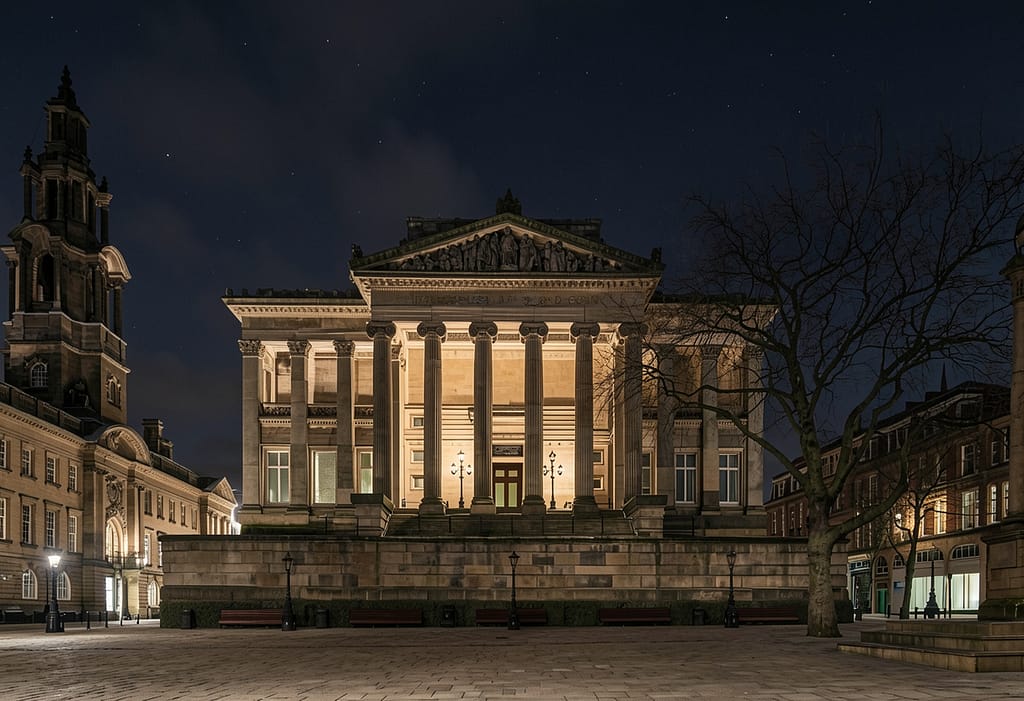
Preston Harris Museum Ghost Stories and the Uneasy Silence of Empty Galleries
The Harris Museum, now known simply as The Harris, stands over Preston’s Flag Market as one of the city’s most recognisable landmarks, a Grade I-listed building founded through the 1877 bequest of Edmund Robert Harris and officially opened in 1893. Its grand Neo-Classical design, towering central hall and long history as a public museum, gallery and library make it the kind of place where footsteps seem to linger even after the rooms have emptied.
Most people meet the Harris in daylight, when the building feels proud, elegant and civic. Yet older museums often change character when the crowds fade, and that is where the fascination begins. Vast rooms, high balconies, sculpture casts, old collections and long lines of sight can make a building feel theatrical at the best of times. In a place like this, silence does not always feel empty. It can feel watchful.
A Preston landmark built to impress
The Harris was created because Preston wanted a serious public institution for literature, art and science, and local support eventually combined with Edmund Harris’s major endowment to make that ambition real. Work on the building started in 1882 and the museum formally opened in 1893, giving Preston a monumental public space that was designed not just to store knowledge, but to inspire awe.
That sense of grandeur still shapes the experience of the place. Six Ionic columns, a decorated pediment and a central hall rising more than 120 feet give the building an almost ceremonial quality. Even before ghost stories enter the conversation, the Harris already feels like a location built for echoes, movement in the corner of the eye and strange acoustics that can unsettle visitors who are alone.
Why museums feel haunted
Museums produce a very particular kind of unease. Unlike busy theatres or pubs, they are full of stillness. Paintings stare. Cases preserve fragments of other lives. Historic objects sit behind glass as if time itself has been pinned in place. The Harris holds collections covering archaeology, local history, fine art, textiles and decorative art, all layered inside one imposing Victorian shell.
That matters because haunted reputation is often less about a single dramatic legend and more about atmosphere. In large historic buildings, people frequently describe the same small experiences: a feeling of being followed, the sense that someone has just crossed a landing, or the impression that a room is occupied when it is visibly empty. The Harris, with its balconies opening onto the main hall and its long internal views, lends itself naturally to that kind of account.
Silent galleries and shadowy figures
The strongest ghost-story angle for the Harris is not a named phantom in one fixed room. It is the repeated idea of presence in spaces that should feel still. Museums with central atriums often create strange visual tricks, where movement on one floor seems to ripple onto another. At the Harris, the height of the hall, the balcony lines and the contrast between lit galleries and darker edges would easily feed reports of shadow figures or someone briefly seen standing where nobody is found moments later.
That kind of haunting is often more convincing to witnesses because it feels ordinary at first. A person turns a corner expecting to meet another visitor. Someone hears steps on stone or wood and assumes staff are nearby. Then comes the awkward pause, the search, and the realisation that nobody is there. In an old museum, that moment can cling to the mind for far longer than a dramatic campfire tale.
The central hall effect
The central hall is the real heart of the building, and probably the space most likely to unsettle anyone left in quiet conditions. Large vertical spaces distort sound. A faint footstep can seem close. A distant door can sound as if it opened on the same floor. Even the hanging Foucault pendulum adds to the strange balance of stillness and motion in the atrium, giving the eye one moving point in an otherwise controlled architectural space.
For paranormal-minded visitors, that creates perfect tension. You are always aware of height above you and open space below you. Balconies invite the instinctive feeling that someone may be leaning over them, watching from another level. In museums, the imagination does not need much encouragement.
Objects and emotional residue
Another reason old museums attract ghost stories is the belief that objects hold emotional residue. The Harris contains collections tied to Preston’s history and much older archaeology, including the famous Poulton Elk remains found with barbed points embedded in the skeleton. Whether or not anyone believes objects can retain impressions, the idea is powerful. It encourages the feeling that museums are not just containers of history but places where the past presses close.
That makes the quieter galleries especially effective settings for paranormal storytelling. Instead of inventing one melodramatic spectre, the more believable angle is cumulative unease: a cabinet that feels oppressive, a gallery corner that people hurry through, or a staircase landing where the atmosphere suddenly turns heavy for no obvious reason. This kind of haunting feels local, grounded and harder to dismiss.
A building that keeps its own mood
The Harris has also gone through major renovation and reopened after extensive restoration, while still remaining rooted in its original Victorian identity. Buildings like this often gain a second life after restoration, but they do not lose their age. If anything, cleaned stone, reopened sightlines and renewed public attention can make people notice the building more intensely than before.
That is why the Harris works so well as a Preston ghost-story subject. It is not a ruin, and it does not rely on shock value. It is elegant, public and respectable. Those qualities make any strange experience feel more jarring. A sudden chill in a derelict building is expected. A sudden sense of company in a polished civic landmark is harder to explain away.
For paranormal enthusiasts, that contrast is everything. The Harris stands in full public view, filled with culture, learning and civic pride, yet it still has the ingredients that feed every enduring haunting legend: age, memory, silence, scale and the uneasy possibility that empty rooms are never fully empty.
See also our Liverpool ghost hunts and DeadLive events Cheshire.
We would love to investigate this location, but right now we are running events at Lark Lane Liverpool, Mayer Hall Wirral, Penrhyn Old Hall, Coffee House Wavertree, Transport Museum Manchester & Antwerp Mansion Manchester.
DeadLive, taking you where the haunting is happening.