
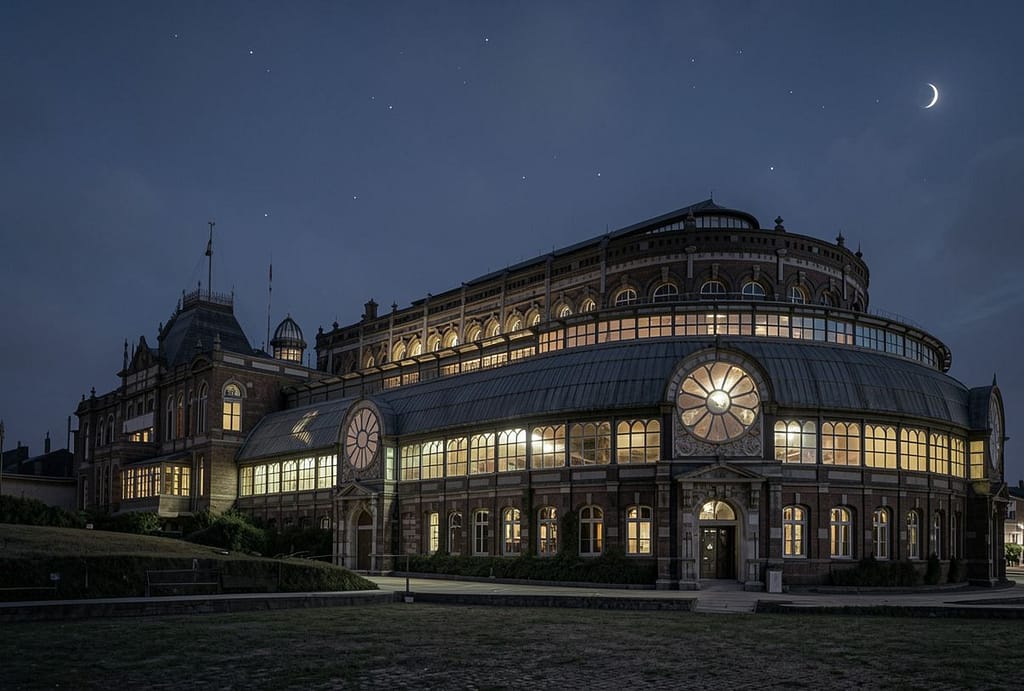
Blackpool Winter Gardens Ghost Stories and the Uneasy Maze Behind the Spotlight
Blackpool Winter Gardens is one of the great entertainment landmarks of the North West, first opened in 1878 and developed across decades into a huge complex of theatres, halls and public rooms that helped establish Blackpool as a premier seaside resort. It is also the sort of building that feels made for ghost stories, because glamour on the public side often hides long corridors, service spaces, stairwells and backstage routes where the atmosphere changes completely.
That is the angle that makes the Winter Gardens especially interesting. People usually imagine the hauntings of famous venues beginning under chandeliers or in bright ballrooms. In truth, the more unsettling spaces are often the ones behind the doors marked private, where the sound fades, the décor narrows, and the building starts to feel older than its showpiece image.
A palace built in layers
The Winter Gardens is not one simple hall. It is a vast complex assembled between 1875 and 1939, with additions that include the Pavilion Theatre, the Empress Ballroom, the Opera House and later spaces such as the Spanish Hall and Baronial Hall. Historic England describes it as a major entertainment complex built around an earlier house, and that layered growth matters because buildings assembled in stages often feel like mazes rather than single venues.
That patchwork quality gives the Winter Gardens its power. Visitors see grandeur, but staff and performers know it as a working organism full of connecting passages, doors, technical areas and routes that were designed for movement rather than beauty. In paranormal terms, those are the parts of a building where strange incidents tend to gather.
The haunted feeling of backstage space
Backstage areas create a particular kind of fear because they are practical spaces, not theatrical ones. There is no dramatic soundtrack and no deliberate attempt to spook anyone. Yet they are full of half-light, old fittings, sudden temperature shifts and unfamiliar corners. At the Winter Gardens, the sheer size of the venue means there are countless transition spaces between public splendour and working darkness.
That is why phantom footsteps make a stronger angle here than a single named apparition. In a building that has handled generations of performers, stage crews, conference staff and visitors, the most believable haunting is repeated movement without a visible source. A door clicks. Someone crosses behind you. Steps travel a corridor and stop. The route is checked, and no one is there.
Corridors, stairs and the sense of being followed
The Winter Gardens contains 11 distinct spaces across roughly 4.9 acres and welcomes more than a million visitors a year, which hints at just how extensive the interior network really is. In a building on that scale, the public only sees a fraction of the whole. The real mystery often lives in what connects the show rooms together.
Long service corridors can distort sound in ways that make footsteps seem nearer or farther than they are. Staircases can transmit vibrations oddly. Doors that open into huge halls can create pressure changes and echoes that leave people second-guessing what they just heard. In haunted folklore, these small uncertainties matter more than dramatic claims. A witness is often most shaken not by seeing a full figure, but by the stubborn feeling that someone is walking just out of sight.
Behind the Opera House
One reason this angle suits the Winter Gardens is the long theatrical history of the site. The first Opera House opened in 1889, was rebuilt in 1911, then after a fire in 1938 the current theatre opened in 1939. That history of rebuilding leaves behind a sense of layers and lost spaces, with older layouts surviving in fragments, memories or architectural traces even after major changes.
Haunting folklore thrives in places where one version of a building has been replaced by another. People feel as though the earlier structure never quite left. In a venue where performances have filled the air for generations, it is easy to imagine phantom movement in side passages, old access points or technical zones that still seem attached to another era.
The Empress Ballroom after the crowd
The Empress Ballroom is one of the Winter Gardens’ most famous spaces, opened in the 1890s and designed for spectacle on a grand scale. But large ballrooms often feel strangest when they are empty. Once the music stops and the people have gone, the open floor becomes almost too still. The polished space reflects sound, shadows stretch farther, and even a harmless creak seems deliberate.
That contrast between performance and emptiness helps explain why so many entertainment buildings attract tales of unseen company. The room has been made for motion, applause and light. When all of that vanishes, the silence feels unnatural. A person crossing it alone may start to notice every tiny sign that the building is not as still as it should be.
Why the Winter Gardens keeps its ghostly pull
The Winter Gardens remains a working venue, not a forgotten relic, and that keeps its haunted reputation alive in a different way. New audiences arrive every year, but the building still carries the weight of earlier generations, older performances and vanished staff routines. It feels inhabited by memory even when there is nobody nearby.
That is what makes Blackpool Winter Gardens such a compelling paranormal setting. It is too bright, too famous and too full of life to fit the usual haunted-house cliché. Yet behind its ornament and seaside confidence lies a hidden geography of passages, stairs and service routes where the glamorous face of the building falls away. In those spaces, the oldest kind of haunting takes hold: not a monster in plain view, but footsteps in the next corridor, movement beyond the door, and the strong feeling that someone else knows the building far better than you do.
See also our Liverpool ghost hunts and DeadLive events Cheshire.
We would love to investigate this location, but right now we are running events at Lark Lane Liverpool, Mayer Hall Wirral, Penrhyn Old Hall, Coffee House Wavertree, Transport Museum Manchester & Antwerp Mansion Manchester.
DeadLive, taking you where the haunting is happening.