
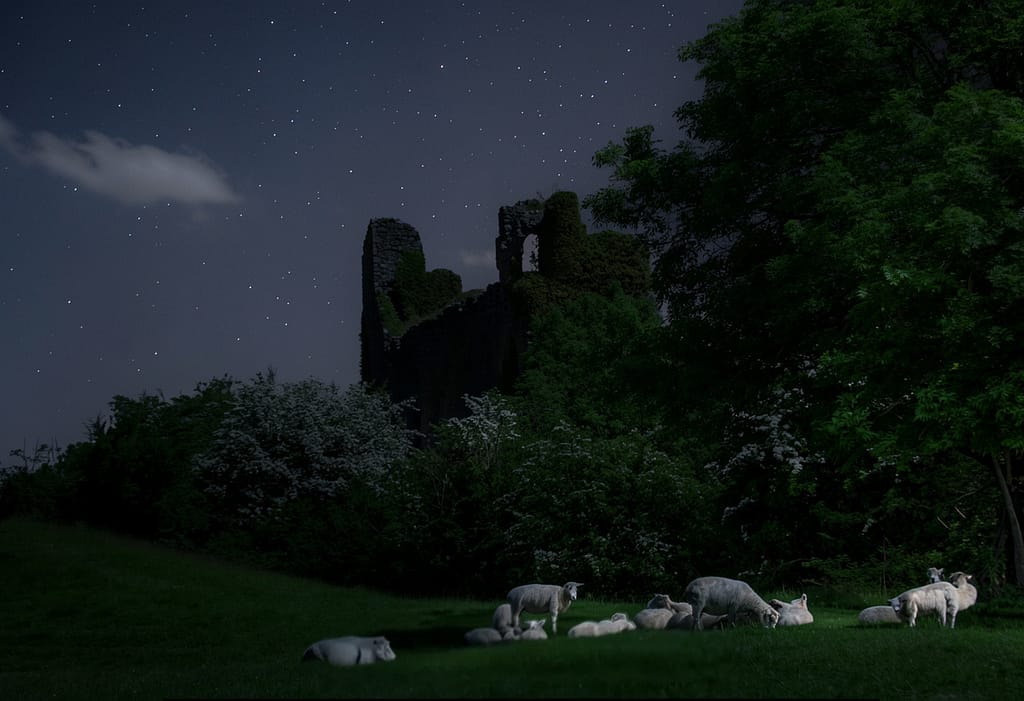
Roscommon Rindoon Island Fortress Ruins
Roscommon’s Rindoon is an Anglo-Norman stronghold that juts into Lough Ree, its walls stretching across the peninsula for more than eight centuries. The ruined castle, church, hospital, harbour quays, and windmill remains still mark a settlement that once controlled a strategic frontier between Gaelic and Anglo-Norman power.
Raiders battered its defences again and again, and the site’s long decline left behind a place that feels suspended between history and legend. Today, the broken stonework, empty foundations, and wind-swept shoreline create the perfect setting for stories of spirits who never truly left.
Wall-top sentries
Wall-top sentries are said to patrol the ruined defences, their footsteps sounding like boots striking stone long after dusk. Visitors have reported fleeting figures on the ramparts, only for them to vanish when approached, leaving behind the sense of a guard still trapped in endless duty.
The mortar here bears the scars of conflict, and that battered fabric of the site adds to the feeling that Rindoon remembers every attack. In the stillness, it is easy to imagine sword-smiths, archers, and sentries frozen in a loop of vigilance.
Harbor Jetty Phantoms
The harbour remains are among the most evocative features at Rindoon, and they lend themselves naturally to ghost stories of phantom boats and drowned traders. Spectral vessels are said to glide toward the jetties, unloading their cargo in silence before dissolving into the mist over Lough Ree.
That image fits the site’s history as a working medieval harbour, once tied to commerce, defence, and travel along the waterway. The same shoreline that once welcomed merchants now gives rise to tales of wet footprints, vanishing crews, and cargo that never reaches shore.
Hospital’s Fevered Cries
The remains of the hospital are especially unsettling because they evoke care, suffering, and the fear of disease in a remote medieval settlement. It is here that stories often place fevered cries, shadowy attendants, and the rustle of bedsheets in rooms that have long since lost their roofs.
Because so little survives above ground, the imagination fills the gaps quickly. That makes the hospital ruins a powerful place for paranormal storytelling, especially when the wind carries a sound that seems almost human.
Why Rindoon feels haunted
Rindoon has all the ingredients of a genuinely unsettling historic site: a strategic fortress, repeated attacks, abandoned buildings, and a long period of decline that stripped away ordinary life. Archaeological and heritage sources describe it as one of the finest deserted medieval settlements in Ireland, with remains including the castle, walls, church, hospital, quays, and windmill.
That combination of military history and isolation makes it ideal for ghost-hunt style writing. You can frame the hauntings as the residue of conflict, disease, and abandonment, or lean into the more folkloric idea that the peninsula itself holds onto the dead.
With over 25 years leading ghost hunts and psychic events across the UK, DeadLive is thrilled to launch monthly investigations at Antwerp Mansion Manchester, a Victorian gem in Rusholme brimming with shadowy apparitions and poltergeist activity. Reports of Victorian ladies gliding halls and cold spots in former bedrooms make it prime for EVPs and table tipping.
Join our packed schedule at Lark Lane Liverpool’s historic police station (clanking cells), Mayer Hall Wirral (eerie whispers), Penrhyn Old Hall (knight shadows), Coffee House Wavertree (café spirits), and Transport Museum Manchester (phantom engines). More thrilling nights added daily—book now for unforgettable chills!
DeadLive, taking you where the haunting is happening.