
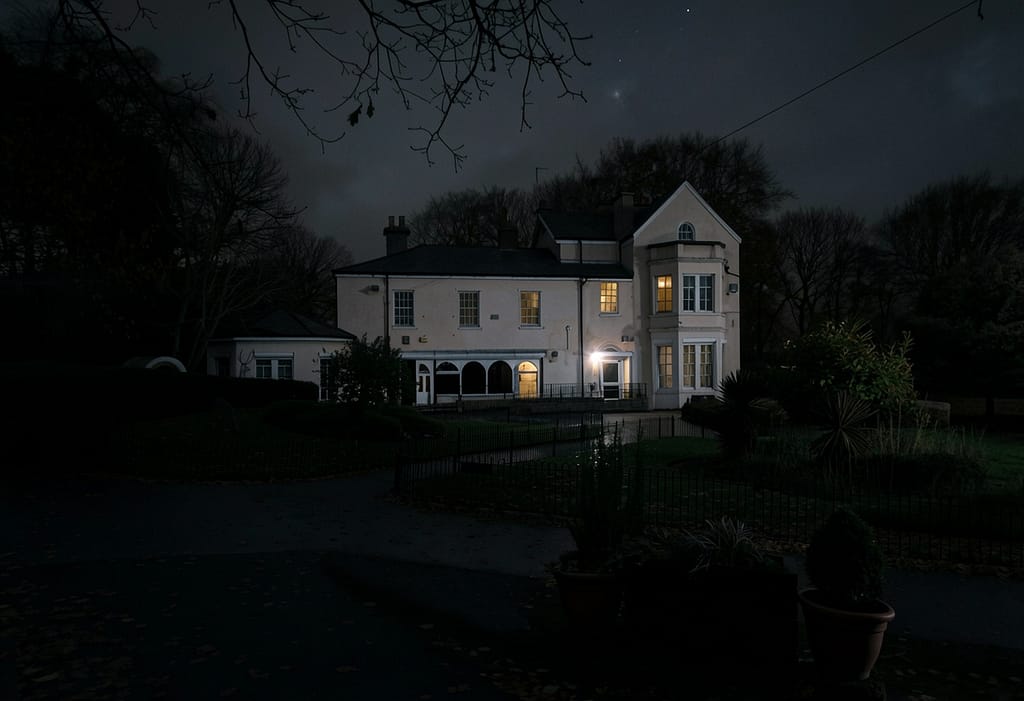
Vale House Ghost Hunt Wirral
Vale House stands within Vale Park in New Brighton and has a history connected with Victorian family life, the author Elizabeth Gaskell and generations of the Burston family. Its development from a private residence into a community building gives today’s visitors a direct connection with more than two centuries of local history.
From Liscard Vale to Vale Park
During the eighteenth century, the coastal land between Rock Point and Seacombe was known as Liscard Common. Following the Enclosure Act of 1809, approximately 25 acres became known as Liscard Vale. Two substantial houses stood in the area: Woodlands and Liscard Vale House, now known as Vale House.
Liverpool merchant Charles Holland purchased Vale House in 1844. The original Regency-style property was considerably smaller than the building seen today. Holland had a large household, including nine children, servants, a coachman and gardeners, so he enlarged the house with an extensive Victorian addition.
In 1898, the house and grounds were sold to David Rappart for £7,000. Five months later, he arranged to resell the estate to Wallasey Urban District Council for £7,750. The council also purchased land from the neighbouring Woodlands estate, helping to create the public park surrounding Vale House today.
Elizabeth Gaskell and Vale House
Vale House has an important connection with Victorian author Elizabeth Gaskell, best known for works including Cranford, North and South, Mary Barton and The Life of Charlotte Brontë.
Charles Holland was Elizabeth Gaskell’s cousin. His wife, also named Elizabeth and known as Lizzie, was the sister of Elizabeth Gaskell’s husband, William.
In a letter written to her daughter Marianne in October 1852, Elizabeth Gaskell described the expansion of Vale House. She referred to its large drawing room, adjoining boudoir, six new bedrooms and handsome entrance hall, together with the staircase connecting the original house to its Victorian extension. Her letters provide valuable contemporary evidence of how the building developed during the nineteenth century.
W.G. Burston, Vale Park’s First Curator
William Grinsell Burston arrived at Liscard Vale in 1890 as head gardener. Following the shooting of Edgar Holland in 1896, W.G. Burston and his family moved into Vale House. When the council took control of the estate, he remained and became the first Curator of Vale Park.
W.G. was responsible for much of the park’s early development, including its paths, flower beds and planting arrangements. He was regarded as an expert botanist and discussed rare plants and seeds with specialists from Liverpool Museum. He was also a keen amateur astronomer who wrote essays on the subject, although none are known to have survived.
W.G. Burston died inside Vale House in 1918. His family maintained a connection with the house and park for more than 50 years.
The Burston Family
W.G.’s wife, Mary Burston, lived at Vale House until her death in 1902 and was buried at Wallasey Cemetery. Their youngest son, Sydney, grew up in the house and later served as a signaller during the First World War. He survived exposure to poisonous gas while repairing communication wires under enemy fire, but his family said that he never fully recovered. Sydney later wrote a poem remembering Vale Park as the garden of his childhood.
Another son, Ernest Burston, was wounded in the throat and foot during the war. He returned to Vale Park and worked as a gardener from 1918 until his death in 1946. During this period, he and his wife lived in Vale House after it had been divided into two homes.
W.G. Burston’s granddaughter, Joyce Paynter, later supplied family photographs and historical information. She remembered happy childhood visits to Vale House and gatherings involving the close-knit Burston family.
Ghost Hunts at Vale House
The different periods of Vale House can still be recognised within the building, from its Regency origins to the larger Victorian additions described by Elizabeth Gaskell. Its long history as a family home, curator’s residence and community building makes it an atmospheric location to investigate after dark.
DeadLive will be holding Vale House ghost hunts on:
Each event offers guests the opportunity to investigate this historic Wirral building and discover the stories of the people who lived and worked within Vale House and Vale Park.
DeadLive, Taking You Where the Haunting Is Happening.