
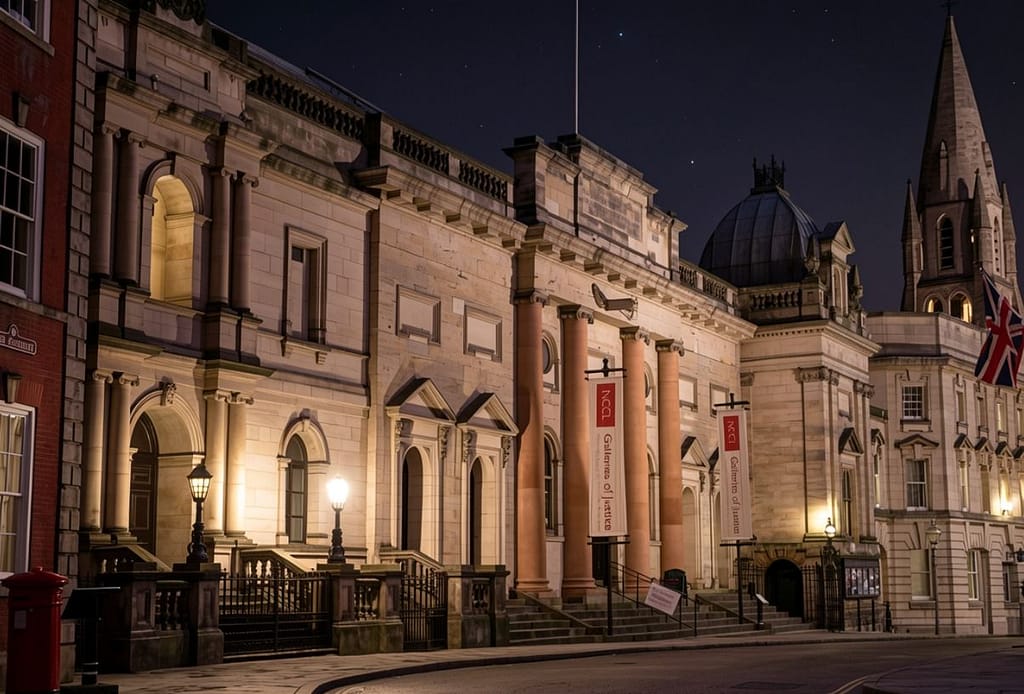
Nottingham Galleries of Justice
Nottingham Galleries of Justice is one of those rare haunted locations where the history alone can make the reader uneasy. The building has served as a court, gaol, police station and place of punishment, and that layering of authority and fear gives it a naturally grim atmosphere. It is also a site where legal history and ghost stories overlap so closely that the two are almost impossible to separate.
The building’s long association with justice goes back centuries, with documented use as a court from 1375 and prison records from the 1400s. That matters for a paranormal article because places with long, continuous human suffering tend to collect stories faster than ordinary buildings. The Galleries of Justice is not haunted in the abstract; it is haunted by the emotional weight of judgement, confinement and execution.
A place of judgement
The courtroom remains one of the most effective parts of the site for storytelling. It still carries the feel of a place where lives were decided in a single moment, and that sense of authority can be unsettling even in daylight. Visitors and investigators have reported knocks, voices, shadows and other activity in the courtroom area, with some accounts describing responses to questioning and sudden disturbances.
That kind of location works well in paranormal writing because it creates a strong visual and emotional contrast. A courtroom is meant to represent order, but here it becomes a place where old tension seems to linger. The result is not just a haunted room, but a haunted atmosphere that feels baked into the structure itself.
Cells and punishment
The prison areas deepen that mood further. The site held prisoners for generations, and the surviving cells still give a sense of confinement that is difficult to ignore. Reports from the site describe footsteps, being touched, dark figures and an oppressive atmosphere in the lower parts of the building. That makes the Galleries of Justice especially strong material for an article about lingering spirits, because the setting naturally supports the stories.
There are also repeated claims of sickness and unease in the pits and underground areas, with visitors sometimes feeling compelled to leave quickly. Whether readers interpret that as suggestion, atmosphere or something stranger, it adds drama to the location. The underground spaces are not just dark; they are the kind of spaces where fear seems to travel faster than light.
Caves and dungeons
The cave system below the building is one of the most intriguing parts of the story. Evidence suggests the underground areas may have been used for imprisonment and punishment long before the later court buildings were formalised, possibly reaching back to around 600 AD according to some historical accounts. That gives the site a depth that goes beyond the visible architecture and into Nottingham’s earlier history.
For a haunted-location article, the caves are ideal because they turn the building into a layered environment. The reader is not only imagining old courtrooms and cells, but also older underground spaces where sound, shadow and memory would have combined in powerful ways. Reports of objects being thrown, bangs, touches and poltergeist-like activity in these areas only strengthen the sense that the lower levels are the site’s most active zone.
Named hauntings
One of the better-known names linked to the building is William Saville, who is said to haunt the site after being executed there. Accounts describe him as following visitors and bringing an unpleasant atmosphere with him, which gives the article a more personal ghost story rather than a general “something is there” claim. That kind of detail helps break up the broader historical description and gives the location a face.
There are also repeated sightings in the reception area, where reports mention a soldier, a Victorian man and an old lady. Elsewhere, cleaners have reportedly refused to work alone because of strange experiences, and that sort of recurring human reaction matters in a paranormal narrative. It suggests the building’s reputation is not just based on one-off stories, but on a pattern of discomfort that keeps resurfacing.
Why it endures
The reason Nottingham Galleries of Justice continues to fascinate is that it combines public history with private fear. It is a museum now, but it still carries the emotional residue of the people who were judged, confined and in some cases executed there. That makes it far more than a generic “haunted building”; it is a place where the stories feel connected to the architecture itself.
The site is old enough to feel rooted, grim enough to feel haunted, and active enough in reported experiences to justify the paranormal angle. It is exactly the kind of place where a ghost hunt story can end on an uneasy note without forcing the drama.
We would love to investigate this location, but right now we are running events at Lark Lane Liverpool, Mayer Hall Wirral, Penrhyn Old Hall, Coffee House Wavertree, Transport Museum Manchester & Antwerp Mansion Manchester.
DeadLive, taking you where the haunting is happening.