
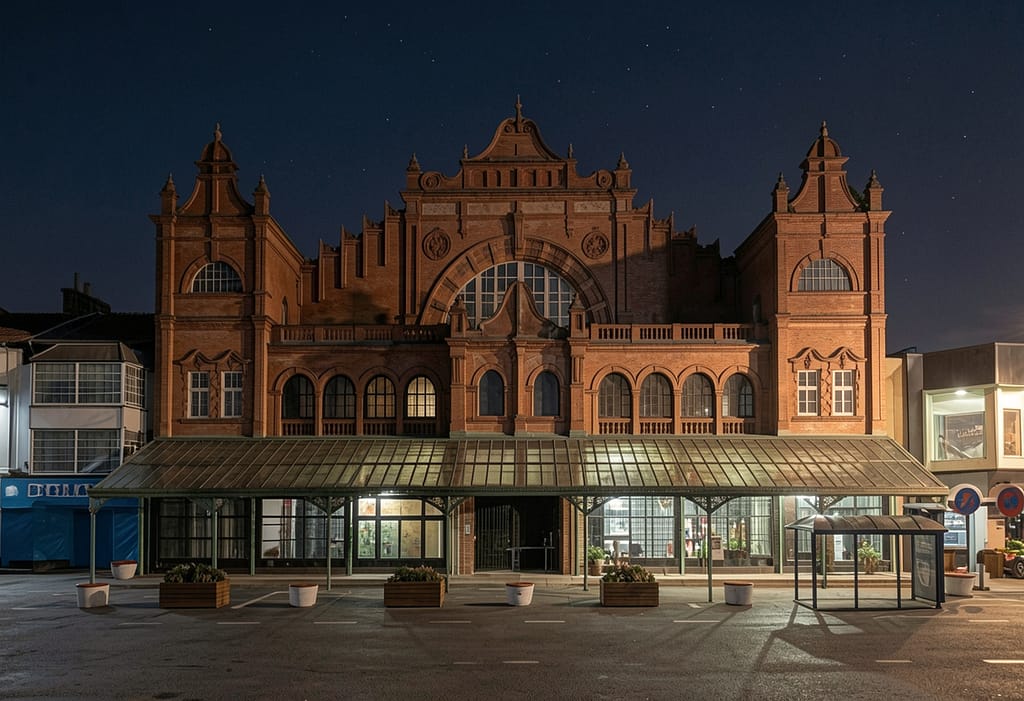
Morecambe Winter Gardens Ghost Stories and the Echoes of a Lost Seaside Palace
Morecambe Winter Gardens is one of Lancashire’s most evocative surviving entertainment buildings, opened in 1897 as the Victoria Pavilion Theatre and built as an extension to an earlier Winter Gardens complex that dated back to 1878. Today it stands not simply as an old theatre, but as the last major remnant of a once larger seaside world of baths, bars, ballroom culture and public spectacle.
That is what makes it such a powerful haunted location. The building feels haunted not only because of what may have been seen or heard inside it, but because so much around it has vanished. Morecambe Winter Gardens carries the atmosphere of a place that outlived its own age. It is a survivor, and survivors often feel full of voices.
Born from a grander resort dream
The theatre that remains today was designed by Mangnall and Littlewood, with Frank Matcham acting as consulting architect, and it opened on 19 July 1897 as part of a broader entertainment complex already established on the promenade. The earlier Winter Gardens development from 1878 included seawater baths, bars, a ballroom and other attractions created for the confidence of the Victorian seaside holiday.
In its prime, the venue was known as the “Albert Hall of the North,” with a capacity of around 2,500 and a reputation strong enough to attract major performers across music, variety and theatre. Sir Edward Elgar, the Hallé Orchestra, Dame Julie Andrews, Laurence Olivier and The Who all appear in the building’s historical roll call, showing just how important the venue once was to Morecambe’s cultural identity.
Why the theatre feels haunted now
Some buildings feel eerie because they are isolated. Morecambe Winter Gardens feels eerie because it remembers crowds. It was built for applause, music, voices and movement. It belonged to a time when the seaside was filled with ceremony and entertainment, when nights out were public rituals and buildings like this stood at the centre of civic pride.
That kind of history creates a haunting of absence. When a theatre has held generations of performers and audiences, silence feels wrong. Empty balconies suggest watchers. Darkened aisles seem to wait for footsteps. Even without a single dramatic apparition, the building invites the sense that the people who once filled it have not entirely gone.
The ghost of what was demolished
One of the strongest reasons Morecambe Winter Gardens works as a ghost-story setting is that only part of the original complex survives. The theatre closed in 1977 during a period of decline in seaside entertainment, and although the remaining theatre was listed that same year, the original ballroom block was demolished in 1982.
That loss changes the emotional temperature of the place. A fully preserved venue can feel grand. A partly demolished one can feel wounded. It makes people imagine the missing rooms, the vanished routes, the erased crowds and the former shape of the complex. In paranormal terms, this is often more effective than a neat intact building, because absence itself becomes part of the haunting. The structure seems to hold outlines of spaces that are no longer there.
Echoes in surviving architecture
The theatre still retains much of its historic character, with lavish detail and the sort of ornate interior that keeps the Victorian entertainment spirit alive. Theatres Trust notes that the surviving building carries detectable traces of Matcham influence even though it is unlike his standard surviving works, which only adds to the sense that this is a place with a very specific personality rather than a generic old venue.
In ghost-story terms, architectural richness matters. Ornate plasterwork, sweeping lines and decorative surfaces reflect light and shadow in strange ways. Large auditoriums alter sound. Empty balconies invite the feeling of being watched. In Morecambe Winter Gardens, the glamour never quite disappears, but it feels faded enough to become uncanny. The building does not look dead. It looks paused.
A stage haunted by memory
The best haunting angle here is not a single named phantom in the wings. It is the weight of repeated performance. A venue that hosted stars from Elgar to rock acts, from variety entertainers to touring productions, has absorbed decades of anticipation and emotional charge. Stages are unusual spaces because they are built for concentrated feeling. Fear, joy, applause, nerves and silence all gather there in exaggerated form.
That can make an empty theatre feel more active than a crowded one. In daylight, it is architecture. In low light, it becomes suggestion. A person alone in the auditorium may feel as if someone has just crossed behind the seating, or that a figure has paused in the balcony. These experiences do not need embellishment. In a place like Morecambe Winter Gardens, the past already supplies enough atmosphere.
Decline, rescue and stubborn survival
By the mid-1970s the venue’s fortunes had fallen with wider changes in British seaside culture, and closure came in 1977. Yet the building did not disappear. Campaigners formed the Friends of the Winter Gardens in 1986, and later preservation efforts continued through the Morecambe Winter Gardens Preservation Trust, which has worked for years to restore and reopen the site.
That rescue story is essential to the mood of the place. This is not simply a haunted ruin. It is a building people refused to let die. Recent restoration work and funding have helped bring the theatre back toward life, reinforcing its role as one of Morecambe’s most significant surviving landmarks. That makes the haunting feel even stronger in one sense, because the building is still in conversation with its own past. It is being pulled forward into the future while still carrying the shape of a lost resort age.
The last witness on the promenade
Morecambe Winter Gardens stands on the seafront as a witness to what the town once was and what parts of it still remain. That is why it deserves a different kind of ghost story. Rather than relying on one sensational tale, the building’s power lies in its status as the last great fragment of a vanished entertainment palace.
If anything lingers here, it would suit the venue for that presence to be collective rather than singular: the impression of crowds no longer visible, applause that belongs to another century, and movement sensed in spaces shaped by people who came for wonder and never quite left it behind. Morecambe Winter Gardens is haunted by glamour, demolition, endurance and memory all at once. That combination makes it one of the North West’s most atmospheric paranormal locations.
See also our Liverpool ghost hunts and DeadLive events Cheshire.
We would love to investigate this location, but right now we are running events at Lark Lane Liverpool, Mayer Hall Wirral, Penrhyn Old Hall, Coffee House Wavertree, Transport Museum Manchester & Antwerp Mansion Manchester.
DeadLive, taking you where the haunting is happening.