
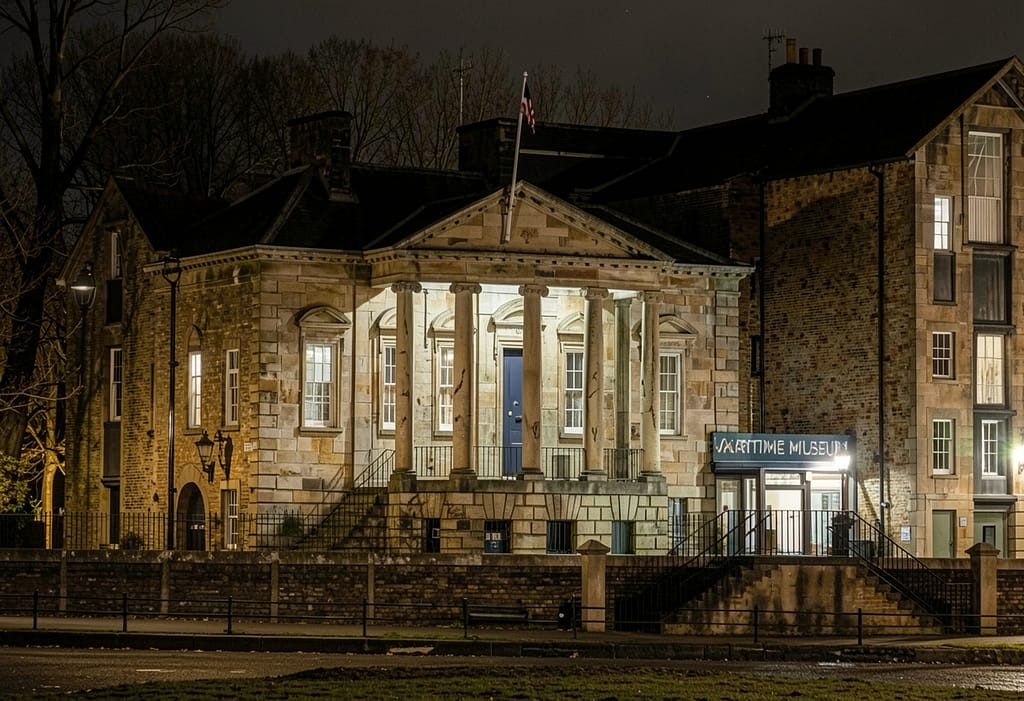
Lancaster City Museum Ghost Stories and the Civic Shadows of the Old Town Hall
Lancaster City Museum stands in the city’s former Town Hall on Market Square, a Georgian building created in the late 18th century and later turned into a museum that preserves the history of Lancaster and its people. That civic background gives the place a different kind of haunting. This is not a crumbling manor or a lonely ruin. It is a public building shaped by authority, order, judgment and memory, and those layers can make it feel strangely heavy once the noise of the square falls away.
Many haunted locations depend on one dramatic legend. Lancaster City Museum works better through atmosphere. It is the sort of building where old staircases, formal rooms and historic displays create the feeling that the past has never fully stepped aside. When a place has spent centuries holding meetings, court business, confinement and public record, the idea of lingering presence starts to feel almost natural.
A building made for civic power
The old Town Hall was built in the 1790s to replace an earlier town hall and provided meeting rooms, court rooms, a town lock-up and a market at ground level. It was designed by Major Thomas Jarratt, with the cupola and upper elements added to designs by Thomas Harrison, and today it remains a Grade II* listed landmark in the heart of Lancaster.
That matters because civic buildings carry a very different emotional charge from private homes. People entered them to argue, petition, answer accusations, settle business and face local power. Even without a named ghost, buildings like this keep a certain seriousness in their walls. They were designed to make people behave differently, and some of that pressure seems to survive long after the original officials have gone.
Why former town halls feel haunted
A former town hall is haunted by routine as much as by tragedy. Day after day, people climbed its stairs with worries, disputes and expectations. Court rooms once concentrated fear and tension. Lock-up cells suggest the panic of confinement. Council chambers held arguments that shaped local life. All of that happened in a structure now visited for culture and history, which creates an unsettling contrast between calm displays and older emotional weight.
That is why the civic angle suits Lancaster City Museum so well. The building does not need exaggerated folklore to feel charged. Authority leaves its own echo. Empty formal rooms can feel occupied simply because they were built for human scrutiny. A landing between floors can feel oppressive not because anyone sees a full apparition, but because the atmosphere abruptly changes and the silence seems to press back.
Georgian staircases and lingering presence
The strongest paranormal image for Lancaster City Museum is movement on the stairs or in the transitional spaces between rooms. Georgian civic buildings create very controlled sightlines. You move upward in stages, passing doors, landings and bannisters that seem to frame the possibility of someone waiting just beyond view.
In haunting folklore, staircases are often where witnesses feel most exposed. They are neither one room nor another. They connect public levels while briefly isolating the person climbing them. In the old Town Hall setting, that feeling becomes even sharper. A visitor can easily imagine footsteps above, a figure crossing a landing, or the sense that someone has paused just out of sight at the top of the stairs. That kind of experience feels subtle, but it is often the most memorable.
Court rooms, lock-ups and unease
The old Town Hall originally contained court rooms and a town lock-up, details that immediately deepen its haunted potential. Buildings associated with confinement and judgment tend to gather darker folklore because they were spaces where people experienced fear in very real terms. Even if no specific ghost story is pinned to one chamber, the function of the building alone gives it a psychological charge.
This is where Lancaster City Museum becomes more than a pleasant heritage site. It is also a preserved shell of civic discipline. A museum display may sit where anxious voices once rose. A corridor may have carried officials, prisoners or petitioners. That overlap between education and former power gives the building a quiet tension that many visitors feel even if they never describe it as paranormal.
The bank vault below
After the Town Hall functions moved to Dalton Square in 1910, the ground floor was later used by a bank, and a large walk-in vault still survives in the basement. Features like that matter in ghost storytelling because they remind people that a building does not live one life. It accumulates identities. Government, court business, trade, banking and museum work all leave traces behind.
Basements and vaults always sharpen the imagination. They are spaces cut off from daylight and regular flow, places where practical use once mattered more than comfort. In a former civic building, such areas can feel less like forgotten corners and more like sealed pockets of atmosphere, holding onto the older moods of the site long after the upper rooms have been restored and interpreted for the public.
The military memory inside
Lancaster City Museum also houses the King’s Own Royal Regiment Museum, which tells the story of the regiment from 1680 through later campaigns including the First and Second World War. That adds another layer to the building’s emotional character. Military galleries are full of remembrance, service, loss and distance, and they often change the feeling of a museum because they bring personal sacrifice into rooms already shaped by civic history.
This does not mean inventing dramatic soldier apparitions. The more convincing haunting here is emotional rather than theatrical. Portraits, uniforms, medals and regimental stories can make a room feel deeply inhabited by memory. Visitors do not need to see anything strange to leave with the sense that the building carries more than architecture. It carries duty, grief and the weight of names that are still being remembered.
A museum watched by its own past
Lancaster City Museum works so well as a haunted location because it remains orderly on the surface. The building is elegant, maintained and open to the public. Yet beneath that calm exterior sits a more complicated identity: town hall, court house, lock-up, bank and museum, all gathered into one structure in the centre of the city.
That layered life gives the building its ghostly pull. If any presence lingers here, it would suit the place to be formal rather than wild: footsteps on the stairs, a shape in a doorway, a sudden heaviness in an old room, or the quiet conviction that someone is still keeping watch over Market Square. Lancaster has no shortage of darker sites, but the City Museum offers something subtler and, in many ways, more unsettling — the feeling that civic memory does not vanish when a building changes purpose. It simply waits more quietly than before.
See also our Liverpool ghost hunts and DeadLive events Cheshire.
We would love to investigate this location, but right now we are running events at Lark Lane Liverpool, Mayer Hall Wirral, Penrhyn Old Hall, Coffee House Wavertree, Transport Museum Manchester & Antwerp Mansion Manchester.
DeadLive, taking you where the haunting is happening.