
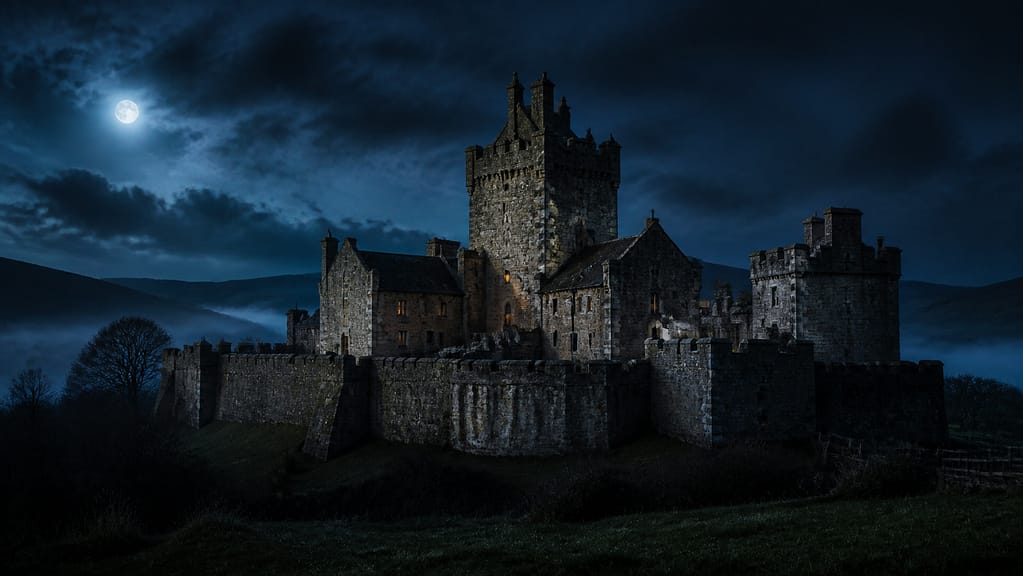
The castle most frequently described as the most haunted in the world is Leap Castle in County Offaly, Ireland. Its reputation rests on centuries of violent family history, the legend of the Bloody Chapel and modern reports of apparitions and poltergeist-like activity.
There is no international authority that counts ghosts, so the title cannot be proved. If the question is limited to Britain, Chillingham Castle in Northumberland is arguably the strongest answer.
Together, the two castles show why “most haunted” is better understood as a cultural reputation than a measurable fact.
Why Leap Castle is the worldwide favourite
Leap Castle is a dramatic tower house whose history has been repeatedly reshaped by conflict, rebuilding and fire. The Leap Castle historical archive distinguishes between documented history, oral tradition, paranormal testimony and later legend—an unusually responsible approach for a place with such a supernatural reputation.
The surviving tower is associated with the 16th century, although the wider castle was substantially remodelled from the 18th century onwards. It was burned in 1922 and later restored, first in the 1970s and again under its present ownership from the 1990s.
Its most notorious legends focus on the Bloody Chapel.
The Bloody Chapel
According to the traditional story, a dispute within the O’Carroll clan ended with one brother killing another—a priest—while he celebrated Mass in the chapel. The episode is often called the “murder of the priest”, although the versions told today combine family tradition and folklore rather than a single complete historical record.
The chapel is also linked with an oubliette: a hidden dungeon where human remains were reportedly discovered during work at the castle. These stories have made it the emotional centre of Leap’s haunting reputation.
Visitors and occupants have claimed to hear voices, footsteps and sudden noises around the chapel. Some describe the sensation of being watched; others report fleeting human forms.
The Elemental
Leap’s most unusual reputed presence is known as the Elemental. Accounts usually describe an oppressive force accompanied by a foul smell and, more rarely, a shadowy figure with a distorted face.
Explanations differ. One tradition connects it with ancient ritual ground; another says violent events at the castle created or attracted the presence. There is no evidence that can settle the story. The castle’s collected haunting accounts present it as testimony and tradition, not a proven biological or supernatural entity.
That distinction is crucial. Leap Castle has genuine history, but its worldwide fame also reflects generations of storytelling, media attention and personal experiences that cannot be independently reproduced.
Britain’s strongest contender: Chillingham Castle
If Leap is the global answer, Chillingham Castle makes the clearest British challenge.
The Historic England listing records a Grade I listed castle with medieval origins, four corner towers and a central courtyard, altered across later centuries. Its position near the English–Scottish border placed it within a landscape shaped by raids, warfare and political tension.
Chillingham openly embraces its supernatural reputation. Its official ghosts page describes reports including the White Pantry Ghost, mysterious voices in the chapel and apparitions seen around the courtyard. The castle hosts ghost tours and allows paranormal teams to investigate by arrangement.
One of its most famous stories concerns the “Blue Boy”, a child’s cries and flashes of blue light allegedly associated with a room in the castle. Details have changed between retellings, which is why the story should be approached as folklore rather than established history.
How should a “most haunted castle” be judged?
A useful comparison looks beyond the number of ghost stories. Four factors matter:
- Documented age and history: Is the building itself genuinely historic?
- Continuity of reports: Have experiences been reported across different periods?
- Independent witnesses: Do accounts come from more than one owner or tour guide?
- Honest presentation: Are documented events separated from folklore and personal testimony?
Leap and Chillingham score strongly because both possess real architectural history and enduring bodies of reported experience. Neither can prove that a supernatural cause produced those experiences.
Other famous haunted castles
Edinburgh Castle has stories associated with spectral music, prisoners and military activity. Bolsover Castle, Dover Castle and the Tower of London also attract major supernatural reputations, while castles across Ireland and Wales have their own local contenders. Several of them appear in our guide to eleven haunted locations in the UK.
This abundance is exactly why a universal winner is impossible. A castle’s reputation depends partly on which stories were written down, promoted, translated and kept alive.
Our verdict
Leap Castle is the best answer to “What is the most haunted castle in the world?” Its Bloody Chapel, the Elemental and decades of reported activity have given it an international reputation few castles can match.
For Britain, Chillingham Castle is the more convincing choice. Its medieval fabric, border history and continuing programme of ghost tours and investigations make it one of the country’s most important paranormal locations.
In both cases, the history is real; the hauntings remain claims. That combination—solid stone, human tragedy and unanswered experience—is what makes a haunted castle story endure.
Frequently asked questions
Is Leap Castle open to visitors?
Leap Castle is privately owned. Access arrangements can change, so check the castle’s current official information and never arrive without permission or a confirmed arrangement.
What is the most haunted castle in England?
Chillingham Castle in Northumberland is one of the strongest candidates. It has a long-standing collection of ghost stories and currently promotes organised ghost tours.
Are castle hauntings proven?
No. Witnesses may sincerely report unexplained experiences, but that does not establish a supernatural cause. History, environment, expectation and folklore can all influence how a place is experienced.
Can I investigate a haunted castle myself?
Only with the owner’s permission. Historic buildings present security, access and safety risks. Browse DeadLive’s authorised paranormal events for organised investigations at approved venues.