
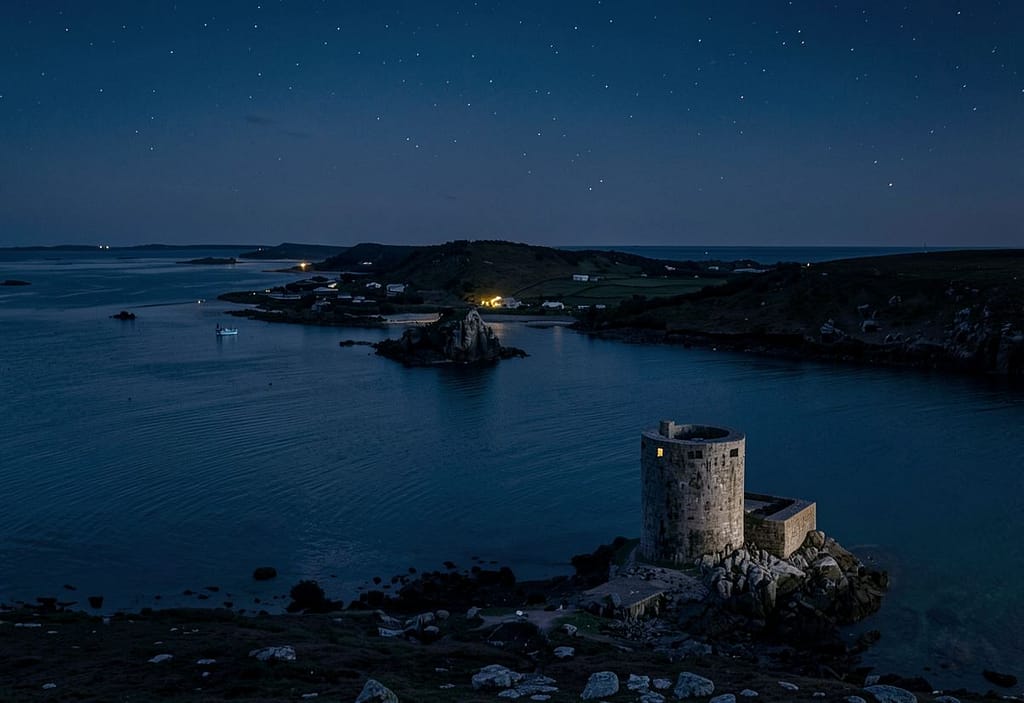
Isles of Scilly: Maritime Hauntings on a Dangerous Sea
The Isles of Scilly are best written as a maritime haunting feature, not a land-based ghost roundup. The archipelago’s strongest legends involve shipwrecks, phantom lights, and the ghost ship Revenge, which gives the islands a sea-bound identity that feels distinct from inland haunted houses and castles. That coastal focus makes the article feel broader and more atmospheric.
The ghost ship Revenge
The most famous Scilly legend centres on Sir Richard Grenville and the ghost ship Revenge. In local storytelling, his spirit is said to haunt the waters, with glowing ship sightings, phantom cannon fire, and the sense of a vessel still patrolling the sea in fog and darkness. That gives the islands a dramatic maritime ghost story with real historic weight behind it.
This is a powerful angle because it combines battle, loss, and seaborne memory. A ghost ship works so well in a feature like this because it is not confined to one building; it moves across the landscape, making the entire seascape part of the haunting. That turns the islands themselves into a stage for apparition and warning.
Phantom wreck lights
Another strong strand is the tradition of phantom wreck lights. Local and visitor accounts describe strange lights over reefs and hazardous water, often interpreted as signs of lost vessels or spirits trying to guide mariners away from danger. These stories reinforce the sense that the sea around Scilly remembers every wreck.
That makes the article more than a single ghost tale. It becomes a wider study of how dangerous waters create folklore over time. The sea is the storyteller here, and the hauntings feel like the afterimage of navigation, loss, and uncertainty.
Why the sea legends work
Sea legends are especially effective because they rely on atmosphere as much as sighting. Fog, darkness, and shifting water all make it plausible that a sailor could see something unexplained and never fully settle the matter. The Isles of Scilly are perfect for that kind of tale because the landscape itself keeps producing ambiguity.
The ghost ship and the phantom lights also give the article a distinct tone from the Shetland pieces. Rather than domestic haunting or ruined-house folklore, this is about storms, wrecks, and moving lights at sea. That difference matters because it keeps the content fresh across the day’s set of articles.
A wider island haunting
The Scilly story also opens the door to other maritime legends, including longships, wreck lore, and the broader myth of ships that refuse to stay sunk. That widens the article without diluting the focus. The result is a piece that feels like an island-wide haunting rather than a single legend repeated.
For readers, the hook is simple: this is a place where the sea itself becomes haunted. That is an excellent identity for a paranormal feature because it feels ancient, dangerous, and alive with memory. The Isles of Scilly do not need a castle or manor house to be eerie; the water does the work.
We would love to investigate this location, but right now we are running events at Lark Lane Liverpool, Mayer Hall Wirral, Vernon Institute Chester, Penrhyn Old Hall, Coffee House Wavertree, Transport Museum Manchester.
DeadLive – taking you where the haunting is happening.