
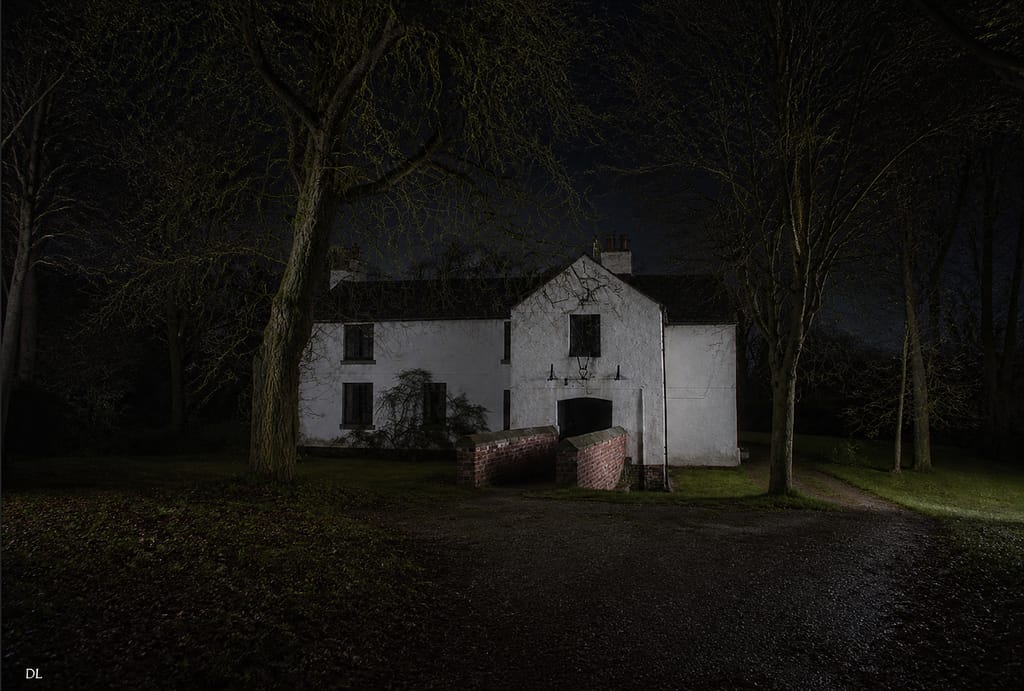
Ask which hall is the most haunted in Britain and one name appears again and again: Chingle Hall, near Goosnargh in Lancashire.
Its reputation is formidable. Visitors and former occupants have reported shadowy figures, unexplained footsteps, a crying child and the apparition of a woman dressed in black. During the 1990s, the hall became nationally known as a place where paranormal activity was said to be almost routine.
That does not make “most haunted” a fact that can be measured. Britain has no audited league table of haunted buildings. But if the title means a surviving historic hall with a long-standing national reputation, Chingle Hall is one of the strongest candidates.
The real history of Chingle Hall
The building’s genuine history is intriguing enough without embellishment.
According to Historic England’s scheduled monument record, Chingle Hall first appears by name in a document from 1354. The hall standing today is believed to date mainly from the early 17th century, with later additions and alterations. It occupies a small moated site, approached by a stone bridge, and both the hall and bridge are Grade II listed.
This matters because many popular accounts say the present house was built in 1260. The official heritage record does not support that simple version of the story. There may have been an earlier building on the site, but the visible hall is principally a later structure.
That correction does not make Chingle less interesting. A secluded house surrounded by a water-filled moat, with centuries of occupation and alteration, has all the ingredients of an enduring ghost story.
How did Chingle Hall become so famous?
Chingle Hall’s paranormal reputation existed before the internet, but it reached a much wider audience in the late 20th century. It appeared in books, newspaper reports and television programmes, and was promoted for overnight visits and investigations.
In 1994, The Independent reported that Chingle was described in reference books as “the most haunted house in Britain”. A court case heard claims that as many as 600 supernatural sightings had been reported over two years.
That figure was an allegation made during a legal dispute, not independently verified evidence. It is still important, however, because it shows how extraordinary the claims surrounding the hall had become.
The ghosts associated with Chingle Hall
Stories vary between accounts, but several figures became closely linked with the property.
The Lady in Black
A darkly dressed female figure has reportedly been seen inside the hall. Some versions of the story identify her with a former occupant, but the apparition’s identity has never been established.
The Weeping Child
Visitors have described hearing a child crying when no child was present. As with many historic-house hauntings, later retellings have attempted to supply a tragic backstory, but the sound itself is the core of the reported experience.
The Headless Man
A headless male figure is another of Chingle’s best-known apparitions. A sceptical but fascinating Independent feature from 1994 recorded this story alongside a much larger cast of reputed spirits.
Other accounts describe footsteps, voices, objects apparently moving and an oppressive atmosphere in particular rooms. These remain personal testimony and folklore rather than proof of the supernatural.
Why the title has endured
Chingle Hall has four qualities that help explain its lasting status:
- It is a genuinely old building on a medieval moated site.
- Its stories were recorded and circulated long before social media.
- Numerous different people claimed unusual experiences there.
- Its secluded appearance perfectly matches the popular image of a haunted house.
There is also an element of mystery. Chingle is not a conventional heritage attraction filled with interpretation boards and busy daytime visitors. It is private property, and nobody should attempt to visit or approach it without permission. That inaccessibility has allowed the hall’s reputation to grow beyond the experiences of any one generation.
Are there other contenders?
Certainly. Samlesbury Hall in Lancashire, Penrhyn Old Hall in North Wales and Speke Hall in Liverpool all have substantial collections of ghost stories. Borley Rectory in Essex was once famously labelled the most haunted house in England, although the building was demolished in 1944.
Chingle Hall’s advantage is that it survives and still carries a reputation established over decades. Its “most haunted” title is not scientifically provable, but it is culturally significant.
Our verdict
Chingle Hall is the best answer to “What is Britain’s most haunted hall?”
The title should be treated as a reputation, not a verified paranormal ranking. Its documented history is sometimes confused with later legend, and dramatic claims should always be examined carefully. Even after those corrections, Chingle remains one of the most compelling haunted locations in Britain.
Perhaps that is the real reason its story lasts: the facts are atmospheric, the testimony is extensive and the unanswered questions remain.
Frequently asked questions
Is Chingle Hall really haunted?
Many people have reported unusual experiences, but haunting cannot be scientifically confirmed. The reports form part of the hall’s modern history and folklore.
Was Chingle Hall built in 1260?
That date is widely repeated, but Historic England says the present building is mainly early 17th century. The name Chingle Hall is documented by 1354, and an earlier building may have occupied the site.
Can the public visit Chingle Hall?
Chingle Hall is private property and is not a public visitor attraction. Do not travel to the property or attempt to gain access without the owner’s express permission.
Where can I attend a legal ghost hunt?
DeadLive runs organised paranormal events at authorised venues, with access agreed in advance. Explore current DeadLive ghost hunts and choose a location you can investigate safely and legally.