
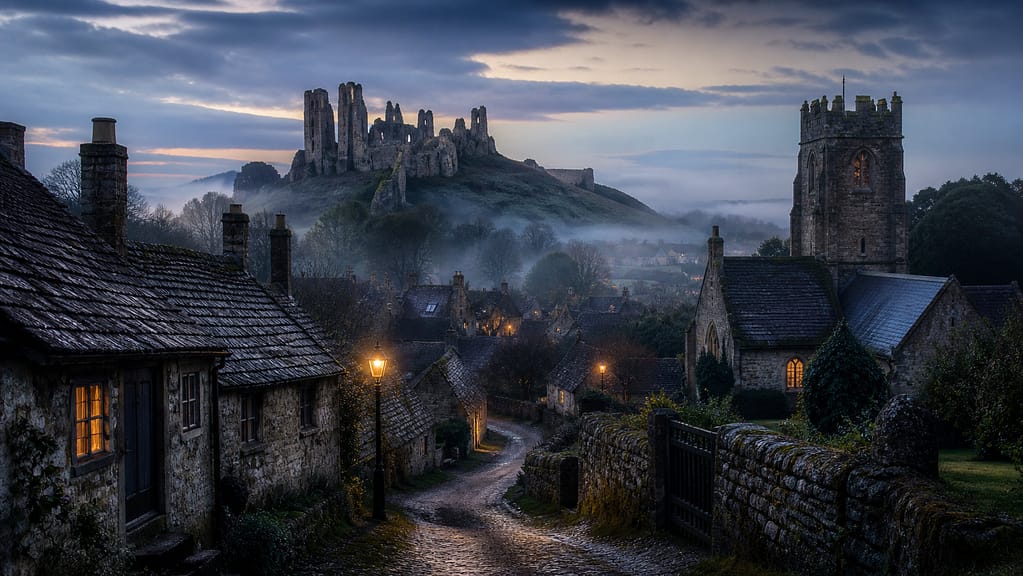
If one country must be named the most haunted in the world, England has perhaps the strongest claim.
From ancient inns and ruined monasteries to royal palaces, theatres, castles and entire villages, England has an extraordinary concentration of recorded ghost stories. It also has a long tradition of collecting, publishing and retelling those accounts.
The title cannot be scientifically proved. There is no reliable worldwide census of hauntings, and a country with more recorded ghosts may simply be better at preserving buildings and documenting folklore. England’s claim is therefore cultural and historical—not an official paranormal world record.
Why England is so often called the most haunted country
Centuries of buildings and stories overlap
England’s landscape contains Roman remains, medieval churches, Tudor houses, industrial sites, wartime buildings and modern cities. Many places have been used, abandoned and reused across several very different periods. Our guide to the most haunted places in England shows how widely those stories are spread.
Those layers create opportunities for stories to attach themselves to real locations. Historic England notes that tales of ghosts, witches and the Devil are woven into English folklore and connected with hundreds of historic places.
A dramatic history does not automatically cause a haunting, but it gives later witnesses a powerful framework for interpreting unexplained sounds, figures and sensations.
Historic sites have been preserved
England has a large number of old buildings that remain accessible. Castles, manor houses, prisons and religious ruins have not vanished entirely beneath new development; many survive as homes, hotels, museums or protected monuments.
English Heritage has observed that supernatural stories are associated with a great many of the sites in its care. Preservation allows a ghost story to remain anchored to the room, staircase or ruined wall where it is said to have occurred.
Ghost stories became part of national culture
England did not merely tell ghost stories—it printed, investigated and debated them. Antiquarians recorded local legends, newspapers reported apparitions, Victorian researchers attempted to study psychical experiences and writers turned the haunted house into a major form of literature.
Research published by Oxford Academic on ghost-hunters in interwar England shows that reports of haunting were connected with wider social and cultural change. In other words, ghost beliefs tell us something about the living as well as the dead.
That tradition continues through tours, paranormal investigations, podcasts, television and local history groups.
Places that strengthen England’s claim
York
Roman, Viking, medieval and modern York occupies several histories at once. Cellars, city walls, narrow streets and ancient inns support a remarkable number of ghost traditions. National Geographic has explored why York is frequently described as one of the world’s most haunted cities.
Pluckley, Kent
Pluckley is reputed to be England’s most haunted village. Local stories include the Red Lady, the Watercress Woman and a phantom coach. The village’s own history page records the reputation while acknowledging how difficult it can be to separate old tradition from stories that grew after publicity arrived.
Chillingham Castle, Northumberland
Chillingham’s reported chapel voices, courtyard apparitions and White Pantry Ghost give England one of the best-known haunted castles anywhere in the world.
Hampton Court Palace
Royal history, death, religion and political upheaval have produced centuries of supernatural tradition at Hampton Court. Catherine Howard’s reputed gallery apparition is among Britain’s most repeated palace ghost stories.
Whitby and the North Yorkshire coast
Whitby combines ruined abbey, maritime tragedy, folklore and its association with Bram Stoker’s Dracula. The result is a place where real history and Gothic imagination continually reinforce one another.
Why the ranking can never be fair
Counting reported ghosts would not solve the question. Countries differ enormously in population, area, record-keeping, media freedom, language and tourism.
A well-publicised English inn may generate hundreds of searchable reports, while an equally important oral tradition elsewhere may never appear online. Some cultures understand spirits as part of religion or everyday family life rather than label them “hauntings”. Comparing those traditions as if they were entries in a sporting league would be misleading.
The most honest conclusion is that England has one of the world’s richest and best-documented haunting traditions—not that it has objectively proven more ghosts.
Which countries challenge England?
Several countries can make powerful claims of their own:
- Ireland has castle hauntings, banshee traditions and landscapes where folklore remains closely connected with place.
- Scotland has Edinburgh’s closes and vaults, Highland battlefields, ancient castles and a deep supernatural tradition of its own.
- Japan has centuries of yūrei stories, haunted sites and religious traditions that do not fit neatly into the Western idea of a ghost.
- The United States has an enormous body of documented paranormal tourism, from former prisons and battlefields to hotels and private homes.
- Romania is internationally linked with Dracula, but its authentic strigoi beliefs and regional folklore are more complex than the fictional vampire image.
Each country’s stories arise from its own history. England’s advantage in the popular ranking is the density, visibility and continuity of its records. The concentration is especially striking in DeadLive’s home region, as our guide to 11 haunted locations in Northwest England demonstrates.
England, Britain or the United Kingdom?
The terms are often confused. England is one country within the United Kingdom. Great Britain comprises England, Scotland and Wales, while the United Kingdom also includes Northern Ireland.
If the question asks for a single country, our answer is England. If it asks for the world’s strongest cluster of connected ghost traditions, the whole of Britain and Ireland would be difficult to rival.
Our verdict
England is the best answer to “What is the most haunted country in the world?”—provided the title is understood as cultural reputation, not scientific fact.
Its combination of preserved buildings, layered history, literary influence, organised research and living folklore has produced an unmatched public archive of ghost stories.
Whether any individual account proves life after death is a different question. What cannot be doubted is that haunting has become part of the way England remembers its buildings, its tragedies and its past.
Frequently asked questions
Which is the most haunted city in England?
York is one of the most frequent answers. London, Chester and Oxford also have extensive ghost traditions, and there is no official national ranking.
What is England’s most haunted village?
Pluckley in Kent is widely reputed to hold the title. Its collection of local apparitions became especially famous through books, newspapers and television.
Does England have more ghosts than other countries?
There is no reliable evidence that it does. England has more recorded and publicised ghost stories than many countries, which is not the same thing as proving more paranormal activity.
Where can I experience England’s haunted history?
Choose authorised tours and investigations that protect both guests and historic venues. Explore DeadLive’s current ghost hunts and paranormal events across England and Wales.