
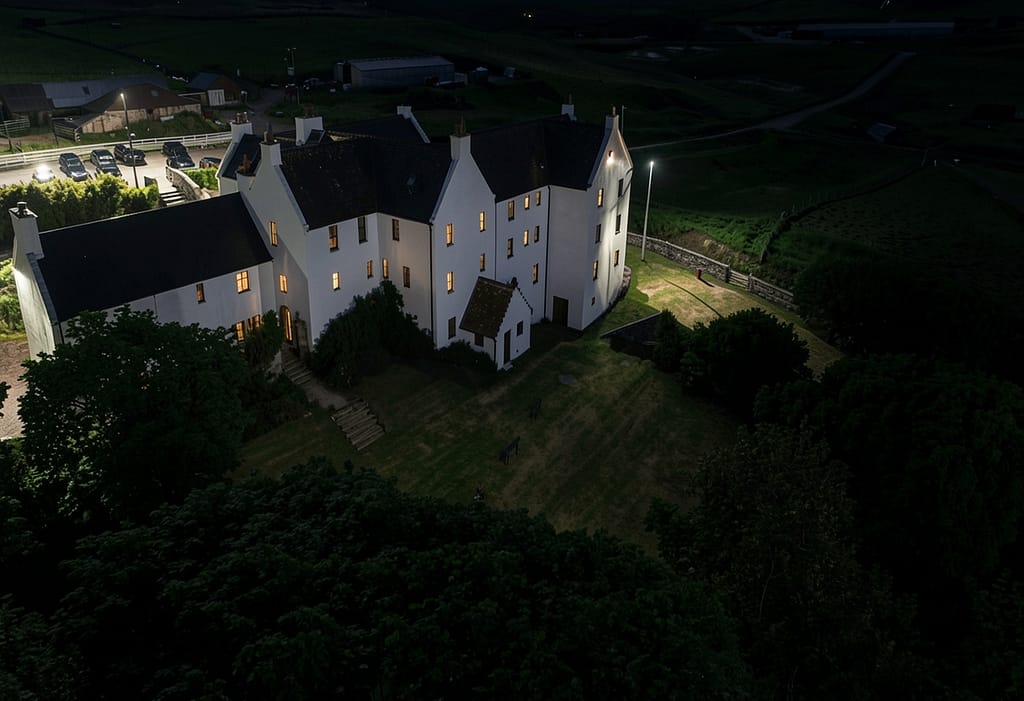
Busta House Hotel, Brae: A Resident Haunting in a Living House
Busta House Hotel is a different kind of haunted place from Windhouse because it is still lived in, hosted, and remembered as a family property. Its haunting centres on Barbara Pitcairn, a resident spirit story that gives the hotel a domestic, personal atmosphere rather than the feel of an abandoned ruin. That makes the site feel intimate, like a house that never quite stopped having company.
A house with family memory
The strength of Busta House is its long association with family history. A resident ghost tradition works best when the building still feels connected to everyday life, and that is exactly what sets this hotel apart from the more desolate Shetland ruins. Instead of focusing on decay, the story invites attention to continuity, hospitality, and the sense that past residents may still be part of the house’s routine.
That emotional quality matters. Barbara Pitcairn’s presence is not framed as a random haunting but as someone tied to the home’s identity. In paranormal storytelling, that kind of link often creates the strongest atmosphere because it feels personal rather than performative.
Barbara Pitcairn’s presence
Barbara Pitcairn is the figure most commonly associated with Busta House’s ghostly reputation. The story places her at the centre of the building’s identity, which gives the hotel a clear and memorable spectral resident rather than a loose collection of unexplained events. That is ideal for a feature that wants a distinct angle and a more human tone.
Resident-ghost stories often endure because they are repeated in domestic language: footsteps, presences, familiar moods, unexplained movement in rooms people still use. That style fits a hotel well, because guests are already sleeping, eating, and moving through old rooms that once belonged to another era. Busta House becomes eerie precisely because it remains welcoming.
Why the hotel setting matters
Unlike a ruined site, a hotel is active, social, and temporary. That means any haunting feels more immediate, because guests arrive expecting comfort and end up meeting a story that belongs to the house itself. The contrast between modern hospitality and old family memory makes Busta House especially effective as a paranormal location.
This also gives the article a better mood than a standard castle or abandoned-building feature. The haunting is not about a broken structure that no longer belongs to anyone. It is about a home that still functions while carrying a shadow of its past occupants.
Shetland’s quieter hauntings
Busta House fits a broader pattern in Shetland ghost lore, where places are often tied to history, family, and landscape rather than to theatrical horror. That creates a different kind of fear: quieter, more domestic, and more persistent. The island setting helps the story because remote places often seem to hold memory more tightly than crowded urban spaces.
For readers, that means the real appeal is not just whether Barbara Pitcairn is seen, but what her presence says about the house. A resident ghost suggests unfinished attachment, and that emotional residue is often more haunting than a violent legend. In that sense, Busta House is as much about belonging as it is about haunting.
We would love to investigate this location, but right now we are running events at Lark Lane Liverpool, Mayer Hall Wirral, Vernon Institute Chester, Penrhyn Old Hall, Coffee House Wavertree, Transport Museum Manchester.
DeadLive – taking you where the haunting is happening.