
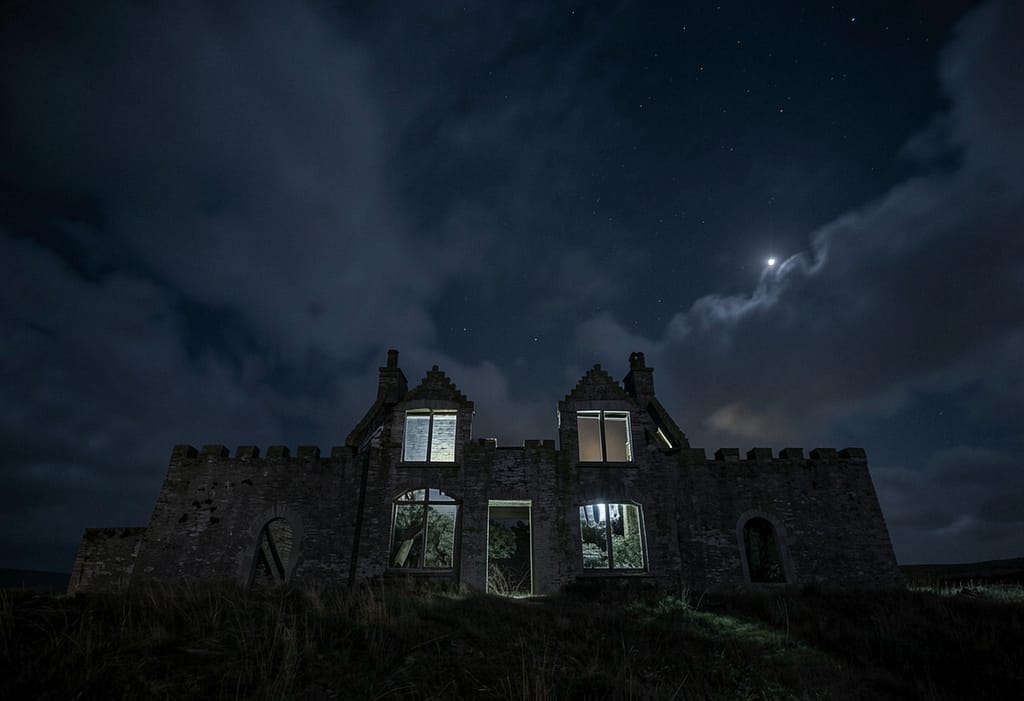
Windhouse, Mid Yell: Shetland’s Haunted Ruin of Many Faces
Windhouse is one of those places where the haunting feels layered rather than singular. The ruined house in Mid Yell has gathered a whole cast of apparitions over time, including the Lady in Silk, a top-hatted man, a dog, and a servant girl. That makes it a stronger story than a simple “most haunted house” retelling, because it blends folklore, local memory, and the eerie atmosphere of a building that has long outlived its original purpose.
A house built on older ground
Part of Windhouse’s power comes from its setting. Local sources say the house was built in 1707, and that it may stand on or near an older burial ground, which adds another layer to the site’s reputation. Even before the ghost stories are told, the ruin already feels like a place where older lives were never fully cleared away.
The building was abandoned by the 1920s, and what remains now is less a home than a memory of one. That kind of ruin invites story-making, especially in a place like Shetland where oral tradition and local observation still matter. Windhouse has become a landmark where history and hauntings overlap naturally.
The Lady in Silk
The Lady in Silk is the best-known presence at Windhouse, and she gives the site its most memorable image. She is described as a woman in a silk dress who appears on or near the stairs, sometimes moving in a repeated pattern before vanishing. One account says her dress is heard before she is seen, with the rustle of silk becoming the clue that something is there.
What makes this apparition especially effective is that it feels tied to the architecture of the house itself. Staircases are often the stage for ghost lore because they create movement, height, and a sense of transition. At Windhouse, the stair story also connects to the discovery of a woman’s skeleton beneath the floorboards during renovations in 1880, which has helped keep the legend grounded in physical evidence as well as memory.
The top-hatted man
If the Lady in Silk is the site’s emotional centre, the top-hatted man is its more unsettling counterpart. He is often described as a tall figure in a black coat and top hat, seen around the terraced area and then disappearing into the structure. That makes him feel less like a domestic resident spirit and more like a figure that watches, waits, and crosses boundaries.
Because Windhouse is a ruin, the man in black becomes part of the building’s silhouette. He is one of those ghosts who seems to belong to the outline of the place rather than to a single room or event. That keeps the story open-ended and gives it a folkloric edge instead of forcing it into one tidy explanation.
The dog and servant girl
The dog and servant girl deepen the haunting by making it feel communal rather than isolated. These figures suggest household life that continued in spirit even after the building fell into disuse. The presence of a servant girl especially changes the tone, because it implies that Windhouse is not only haunted by figures of status or tragedy, but by the ordinary lives that once kept the house running.
That mix of witnesses and entities is what makes Windhouse so effective as a paranormal location. A single ghost story can feel invented or flattened, but several separate presences create a sense of continuity across generations. In Windhouse, the haunting reads like a social memory: a house remembering the people who passed through it, and the people remembering the house.
Why the legend endures
Windhouse endures because it is both ruin and record. The house is dramatic enough to feel haunted, but the stories around it are specific enough to resist cliché. The repeated stair sightings, the top-hatted figure, the animal presence, and the servant girl all give the place a layered identity that is more interesting than a generic “most haunted house” label.
That is also why Windhouse works so well in local paranormal storytelling. It invites readers to think about what survives in a place after abandonment: architecture, folklore, family memory, and the feeling that a home can keep its own witnesses. For a story-focused feature, that is much richer than a simple scare piece.
We would love to investigate this location, but right now we are running events at Lark Lane Liverpool, Mayer Hall Wirral, Vernon Institute Chester, Penrhyn Old Hall, Coffee House Wavertree, Transport Museum Manchester.
DeadLive – taking you where the haunting is happening.