
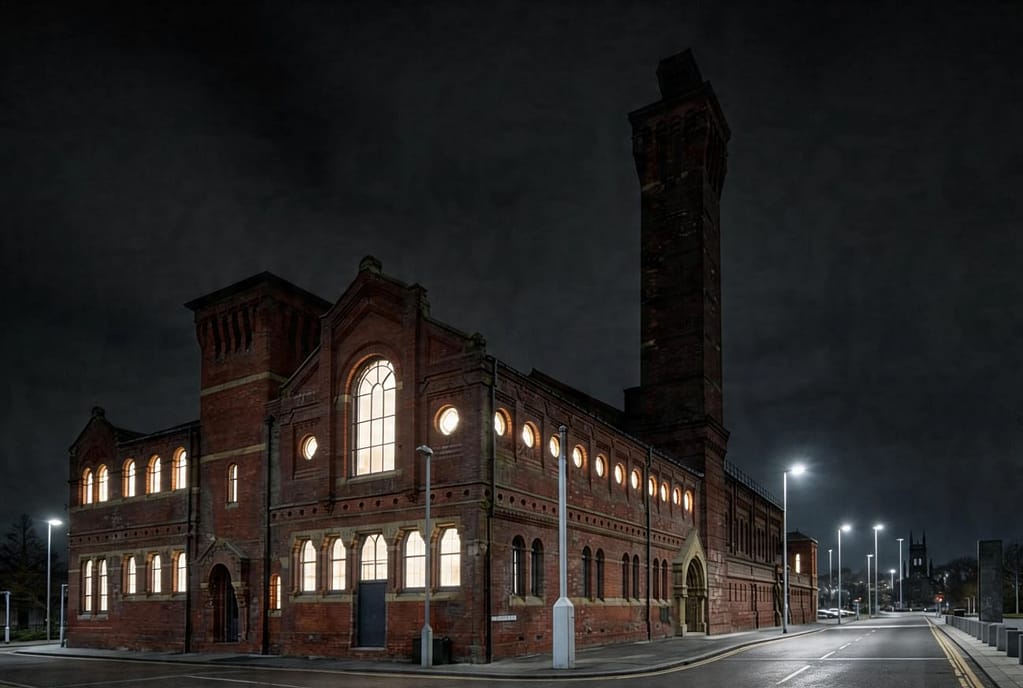
Ashton Old Baths offers a very different kind of haunting from the grand hall or the cathedral. This is a civic building with a practical past, which is exactly what makes it interesting: old public spaces often store as much atmosphere as the grandest houses, only in a rougher, more echo-filled way.
Its ghost story appeal comes from contrast. A place once used for bathing, routine, and public life is now reported to hold children’s laughter, splashing sounds, strange drafts, and a persistent sense that something unseen is still moving through the building.
From public utility to eerie setting
The strongest ghost stories often emerge from places that were built for everyday use. Ashton Old Baths is not a castle or a manor house, which gives it a more grounded, urban mood. That makes it ideal for a Manchester article that leans into the city’s industrial and civic history rather than its more obvious haunted landmarks.
The building’s past as a bathhouse matters because water, steam, changing rooms, and tiled spaces naturally create sound, reflection, and a sense of hidden movement. In a paranormal context, that kind of setting is perfect: it feels alive even when empty.
Reported activity
Accounts linked to the site describe the sound of children laughing and splashing in water long after the pool was drained. There are also reports of cold drafts, slamming locker doors, rustling clothing, and an overwhelming sense of unease in the changing rooms.
Those details work well for storytelling because they are sensory rather than theatrical. Instead of dramatic apparitions, you get noises, temperature changes, and the feeling that the building still remembers the routines of the people who used it.
Why it feels haunted
Part of the charm of Ashton Old Baths is that it does not need a medieval legend to feel unsettling. The building’s old public role gives it a built-in human history: families, children, staff, and the everyday life of Victorian Manchester all leave a trace in the imagination.
That trace can become a ghost story even without a named spirit. A place like this invites readers to imagine footsteps in corridors, voices in echoing rooms, and the way water-focused architecture can turn sound into something strangely alive.
Why it deserves attention
This is exactly the kind of venue that could anchor a fresh Manchester article because it opens a different angle on the city’s haunted past. It is less about famous names and more about atmosphere, social history, and the uncanny afterlife of a public building.
For DeadLive, it would work well as a piece about Manchester’s overlooked haunted places, especially if you want to move beyond the usual “most haunted house” list format and into something with more local texture.
Manchester Cathedral Ghost Stories | Medieval Spirits in the City Centre
Meta description: Manchester Cathedral ghost stories, from the Black Dog to monks and whispers, inside one of the city’s oldest sacred spaces.
Tags: Manchester ghost hunt, Manchester Cathedral, medieval Manchester, black dog, monk ghost, haunted cathedral, ghost hunts, city centre haunt
Manchester Cathedral is one of the city’s strongest haunted locations because it combines age, sacred space, and a deep catalogue of legend. It already appears in your DeadLive archive, so the best approach here is a new angle: not a general recap, but a focused look at the Black Dog, the monk, and the cathedral’s eerie medieval atmosphere.
That makes it ideal for a polished rewrite. The site already has the ghost story reputation; what it needs is a sharper framing that highlights why the building continues to inspire unease.
A cathedral built for echo
Cathedrals are naturally good ghost-story settings because of the way they handle sound. Long aisles, stone floors, and high ceilings turn even a soft footstep into something dramatic, and Manchester Cathedral uses that effect to full advantage.
Its medieval roots also matter. Old religious buildings often carry stories of prayer, loss, duty, and punishment, which gives haunting traditions a strong emotional base rather than a random one. In Manchester Cathedral’s case, that sense of age is part of the atmosphere before a single ghost is even mentioned.
The Black Dog legend
One of the strongest modern angles is the Black Dog. DeadLive’s own page describes the creature prowling the nave, with heavy paws, red eyes, cold spots, and growls recorded in EVP-style reports. The idea of a black dog is powerful because it sits between omen and apparition: not just a ghost, but a warning.
That makes it more than a standard sighting. It turns the cathedral into a place where folklore and fear meet, and that is a far stronger angle than simply listing every old story in one block.
Monks, whispers, and unease
Alongside the dog, the cathedral is said to be haunted by ghostly monks and a hooded figure drifting the tower stairs. The monk imagery works especially well in sacred spaces because it feels like a continuation of the building’s purpose rather than an interruption of it.
There are also reports of whispers, sudden chills, and strange shadows near the altar and Lady Chapel. Those details are effective because they keep the article grounded in atmosphere instead of spectacle.
We would love to investigate this location, but right now we are running events at Lark Lane Liverpool, Mayer Hall Wirral, Penrhyn Old Hall, Coffee House Wavertree, Transport Museum Manchester.
DeadLive – taking you where the haunting is happening.